

The challenge
Raj Filter makes wire-mesh circles, filters and gaskets to customers' drawings. Almost every order is different, and each one moves from quotation through work order, production, packing and dispatch.
The business ran on an ASP.NET WebForms system built years earlier. It still took orders every day, but it was hard to change, kept no proper stock ledger and could not give the owners a live view of the factory.
Replacing it in one go was not an option: the factory could not stop taking orders while a new system was built.
What we built
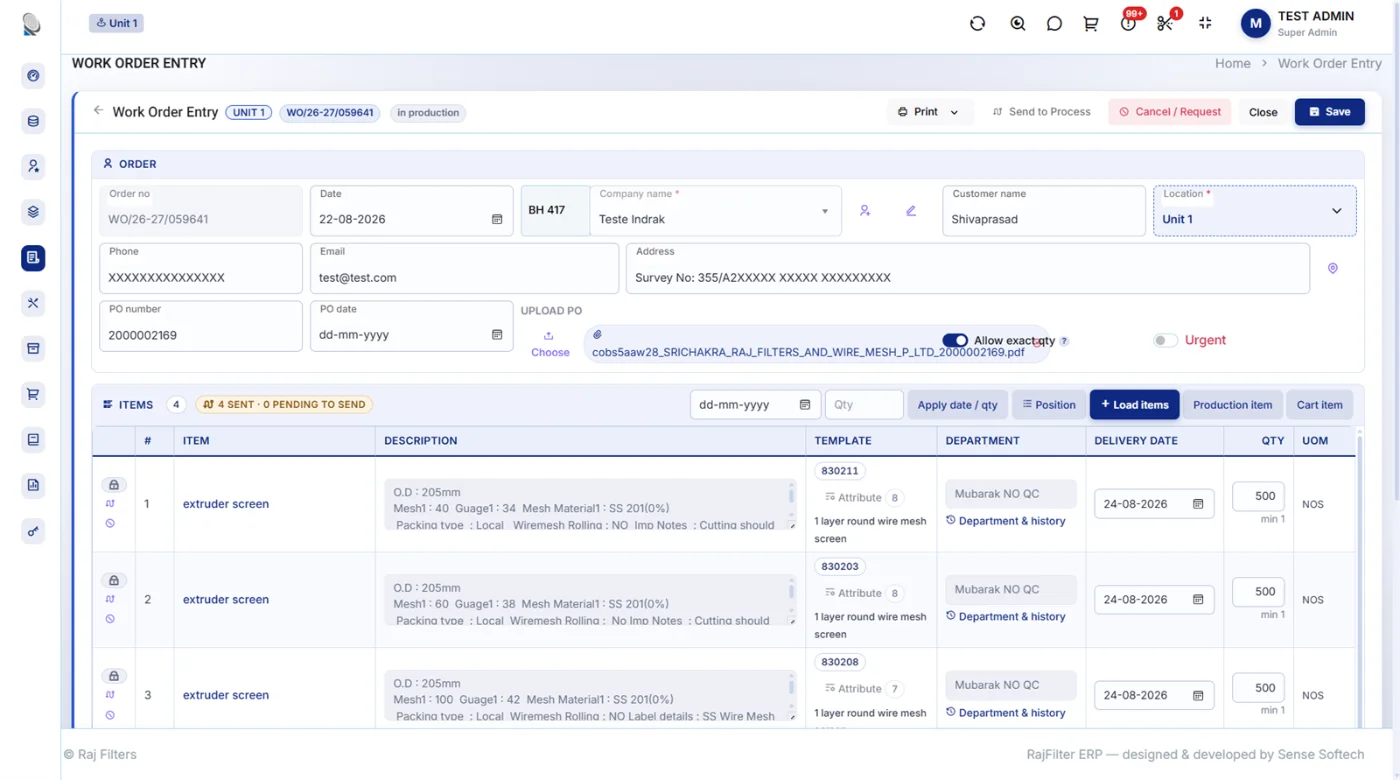
Order to dispatch in one chain
Quotation, work order, production, packing and dispatch, each document created from the one before it, never re-typed.
A live production board
A work-in-progress board per production stage, with a late-order predictor that flags orders at risk.
Purchase with comparison
Requisition, supplier quotation compare, approval, purchase order and goods received.
Sales visibility
A marketing dashboard and a customer win-back list of customers who have stopped ordering.
Accounts from the same documents
Double-entry accounts and GST-ready invoicing posted from the documents the factory works on.
How we did it
- Study the old system first. We mapped every module and the business rules held in the old stored procedures before writing new code, so nothing the business relied on was lost.
- Clean the catalogue. Customer and item data was repaired before it was moved, because a new ERP on bad masters only repeats old mistakes.
- Build in phases. Foundation, catalogue, sales, production, inventory and purchase, then accounts and reports, each phase usable on its own.
- Run side by side. The old system kept taking orders while the new ERP went live, so the factory never stopped.
Where it stands today
The new ERP runs on ASP.NET Core and SQL Server and is in daily use.
It is extended phase by phase with the people who use it, and supported by the team that built it.